Friday, December 28, 2012

CURB CUT

Here's one more arsenal-related observation about Florida's The Villages: interestingly, most residential neighborhoods in The Villages lack curbs:


In fact, with the exception of the gravel patch in the foreground (which has a fire hydrant placed strategically on it) there is not an inch of road frontage on this street that is not a curb cut for a driveway. It's actually quite ingenious, in a Dr. Evil kind of way. We have seen how FIRE HYDRANTS, FIRE ZONES, and RESIDENTIAL PARKING PERMITS can be used to keep non-residents out of a residential neighborhood by restricting parking, but not building curbs is actually a much simpler, much more straightforward weapon for this. Not only is there no place to park - there is no place to even pull over and rest. It's bound to make any visitor feel like a 21st century Flying Dutchman.

The Blockbuster

While we're on the topic of weapons of exclusion and inclusion in pop culture, check out this fascinating All in the Family episode about blockbusting:


It's a very interesting episode, and in Part II, Meathead does a decent job of describing the blockbusting game. On the other hand, the episode's racial dynamics are pretty messed up. It is unfortunate, for example, that the writers chose to make the blockbuster black. With a black blockbuster, the lesson of the episode is that it is wrong to exploit your own people. The black man takes the heat, and the primarily white audience of the show is relieved of having to confront the racial injustice that is at the heart of blockbusting, and the essential truth revealed by the Kerner Commission just four years before this episode aired, namely, that "white society is deeply implicated in the ghetto. White institutions created it, white institutions maintain it, and white society condones it." This racial dynamic is only reinforced at the end of the episode, when Archie Bunker goes out to rally the neighborhood to not sell out and be duped by the black man.

TV Nation - The "Public" Beaches of Greenwich, CT


Thursday, December 27, 2012

"FOR SALE" SIGN BAN


Communities sometimes organize to try to ban "for sale" signs in front of homes. Why? What's interesting is that the "for sale" sign ban has been used to promote residential integration and segregation. Indeed the "for sale" sign ban is one of those ambiguous, double-agent weapons that--like ADULT SWIM, APARTMENT SIZE, NEIGHBORHOOD COMPOSITION RULE and others that remind us that how a weapon is used is often more important than what it is.

One the one hand, "for sale" signs can be (and indeed have been) used by unscrupulous, blockbusting real estate brokers to pedal panic in white neighborhoods. A big, colorful "for sale" sign in front of house signals a homeowner's decision to leave town; a cluster of such signs is likely to incite paranoia and fears of a racial turnover, which in turn incites white flight. Demand goes down, property values plummet, and said unscrupulous broker is standing by, ready to swoop in, buy up, and flip the properties to black families for twice what he bought them for. For this reason, the “for sale” sign ban is sometimes used by Civil Rights groups and integrationists: ban the sign, and you take away one of the blockbuster's chief tools. (Using the same argument, the same groups have also unsuccessfully tried to ban "sold" signs). But the "for sale" sign ban has also been used by racists to maintain or promote segregation. Especially in the pre-internet era, simple, handmade signs made it possible for people to sell homes without the aid of real estate brokers. Banning "for sale" signs makes it more necessary to go through brokers, who, with through their multiple listing service, segregated classifieds, and racist code of ethics, would ensure that a white home would not be sold to a black family and vice versa.

Sunday, December 2, 2012

GATED COMMUNITY, FAKE

We recently took a field trip to Florida's The Villages, officially the largest retirement community in the world. The Villages is fascinating for many reasons, but here we'd like to focus on one particularly Arsenal-worthy reason, namely, that fact that it is essentially fake GATED COMMUNITY. 

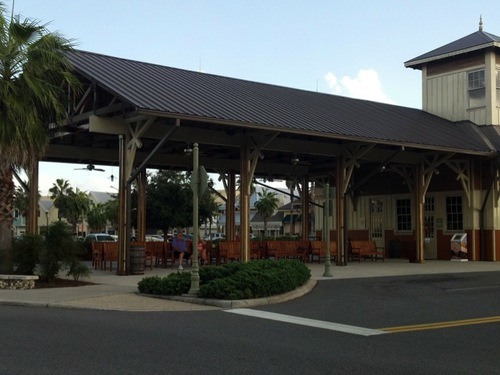
Now there are a lot of fake things in The Villages. There are fake train stations:


fake shipwrecks:


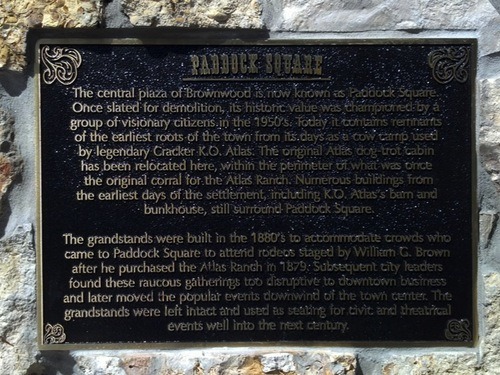
fake histories:


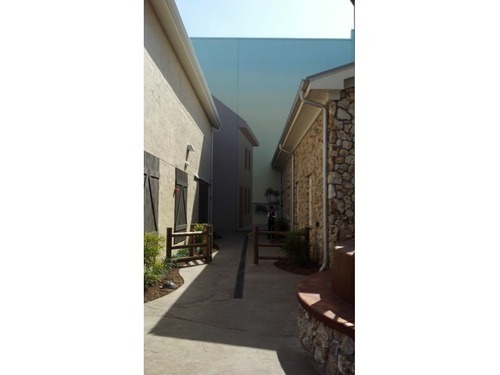
and trompe l'oeil around every corner:


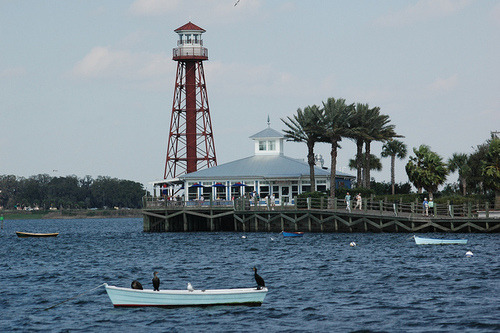
On Lake Sumter (a man-made lake), there is even a fake lighthouse!


That is to say the designers behind The Villages are great at faking it. For the most part, this is fairly benign, and even a little fun (although it can at times be a bit creepy).

But here's an instance of something really sinister: it's essentially a fake gated community. Since most of The Villages is served by State and County roads, The Villages can't be a gated community, since you cannot deny access to a public road to non-residents.

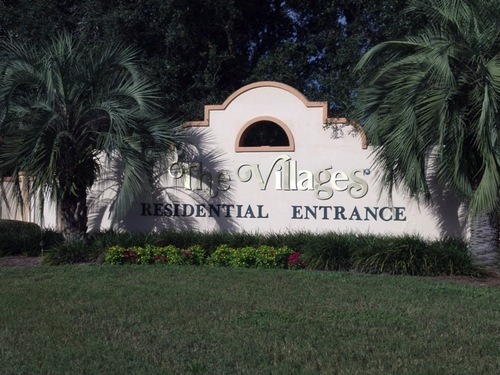
Here's how The Villages gets around this. It starts with a sign that reads "The Villages Residential Entrance."


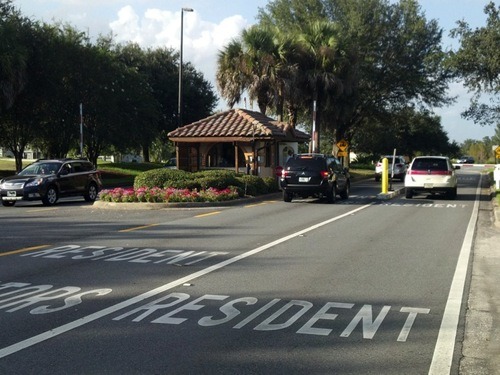
Next to the sign is a gate and security hut:


Notice that the lane on the right is for residents while the lane on the left--nearest the security booth--is for visitors.

Again, this is a public road. How can this exist?

Basically, the whole thing is an elaborate hoax meant to make outsiders think it's a gated community (and thereby turn around): the gate opens automatically regardless of what lane you're in, and the guard has no authority to deny access to anyone (although he could presumably alert The Villages security to the infiltration of anyone who might look like they don't belong). 

Tuesday, July 24, 2012

The Arsenal of Exclusion at Boston's Urbano Project

Interboro is beyond honored that Urbano in Boston chose our forthcoming book on exclusion and inclusion in the built environment as its 2012 - 2013 theme. From their website: "Urbano's 2013 project theme is Narratives of Exclusion: Racial and Cultural Boundaries in the Urban Landscape, inspired by architect and urban planners Interboro Partners' recent book The Arsenal of Exclusion & Inclusion. Interboro Partners' Dan D'Oca, Tobias Armborst, and Georgeen Theodore explore ways in which urban design and architecture influence culture and relationships, and how urban planners can challenge segregation, exclusion, and boundaries between communities."

Join Urbano on Saturday, July 28 for an interactive cross-genre summer literary slam! You can find more about the event here.


If you are in Boston please go to this event and support this amazing organization. 

Sunday, July 22, 2012

Arsenal of Exclusion & Inclusion in Mashable

Interboro and the Arsenal of Exclusion & Inclusion are featured in this article about income inequality in Mashable.

Monday, July 2, 2012

Edward T. "Ned" Coll

Here's a great piece in the History News Network by our pal Andrew W. Kahrl on Edward T. "Ned" Coll, an amazing, unsung hero of open cities everywhere. We highly recommend this reading in advance of your July 4th celebrations!    

Saturday, June 16, 2012

Beverly Hills and NIMBYism

There's a nice piece in Salon's Dream City blog about the controversy surrounding Los Angeles's West Side Subway Extension. To make a long story short, Beverly Hills is trying to derail a planned alignment under Beverly Hills High School. Their argument is that as planned, the subway could ignite pockets of methane gas located under the school and basically blow it up. Their proposed alternative is to run it under Santa Monica Boulevard, which planners criticize for being too close to a fault line. Dream City implies that this is a classic NIMBYist plot (which it probably is), but the article also looks at NIMBYism more broadly, looking at how DISCRETIONARY REVIEW, CITIZEN ADVISORY COMMITTEES, California's ENVIRONMENTAL QUALITY ACT and other post-urban renewal mechanisms meant to give localities more decision-making power facilitate NIMBYism (something we have written about here, here, and here. The article also alerted us to two very interesting studies on the psychology of NIMBYism: Toby Ord's “The Reversal Test: Eliminating Status Quo Bias in Applied Ethics,” which introduces "status quo bias" as "an irrational desire for things to stay exactly as they are, even when change would be beneficial," and David Ropeik's “How Risky Is It, Really? Why Our Fears Don’t Always Match the Facts,” which deals with “prospect theory,” or the theory that the sting of losing something is more intensely felt than the pleasure felt from some gain. Combine these with good old fashioned racism and you have a recipe for our built environment. 

Monday, April 23, 2012

COMMUNITY SUPPORT

There's another sad story about low-income housing and segregation in today's New York Times, this one from Texas. It's a familiar enough story about nimbyism, but it's interesting to point out the "weapon" that nimbyists successfully used to steer low-income housing units towards poor, minority neighborhoods. To decide where low-income units go, a scoring system is used in which "COMMUNITY SUPPORT" is the second-biggest point-getter (behind financial feasibility). Not surprisingly, more organized communities--which are typically among the wealthier communities--(which are typically among the more nimbyist communities), don't support low-income housing, and the units follow the path of least resistance. As a nonprofit developer quoted in the article put it: “Usually your more organized neighborhoods and communities are ones that have more resources, and those are the ones that are going to get organized more quickly if they don’t want you there.”   


Friday, April 6, 2012

Urban Renewal Brochures from 1956

Who did 1956 URBAN RENEWAL propaganda better, New York City or Baltimore? You decide:


The Arsenal of Exclusion & Inclusion on 99% Invisible

The Arsenal of Exclusion & Inclusion is the topic of the latest edition of the awesome radio show 99% Invisible! Check it out here.

In the show Dan gives a tour of some of Baltimore's "exclusionary offerings," including the "museum of exclusion" that is Greenmount Avenue. Here are some pictures of some of the weapons that Dan talked about:


Wednesday, April 4, 2012

The Right to the Westchester Lifestyle

If you ever want an example of how incredibly clueless Americans are about the effects of segregation, read the comments in this New York Times article about the ongoing troubles in the Westchester Desegregation case (which is depressing even without the comments). Here are some gems:

"Housing is not a function of race, its a function of economics that determine where you live, you have to earn the necessary income to be able to purchase and maintain a home. Thats the American dream, get an education, work hard, have a family, buy a home and save for the future generation."

"People moved to Westchester to have a certain lifestyle. That is their right. If poor Hispanics and black people want to move here they should have to have the money to do it."

"I don't care who you are, if you intend to build subsidized housing next to my nice house, I'm going to scream bloody murder. I've worked hard for 20 years, my house is a significant investment for me, and no government hack has the the right to cut it's value by half or more simply by fiat."


Sunday, April 1, 2012

FRAT BAN

None of us were in fraternities, and neither do any of us have a particular soft spot for people who join them. Nonetheless, to our running list of victims of the Arsenal of Exclusion—which includes blacks, the poor, Jews, the homeless, immigrants, teenagers, the disabled, revelers, tourists, farmers, beach-goers, homosexuals, straight people, and people without children—we have to add the frat boy. Why? Because there is a weapon of exclusion—the FRAT BAN—aimed right at them, and just as liberal, ACLU attorneys sometimes defend the free speech rights of racists, bigots, homophobes, and other individuals and groups whose political positions are antithetical to their own, so too must we defend the frat boy against those who wish to exclude him and deny his right to the city.

As the U.S. Supreme Court has noted, “The regimes of boarding houses, fraternity houses, and the like present urban problems. More people occupy a given space; more cars rather continuously pass by; more cars are parked; noise travels with crowds.” And as Patricia E. Salkin and Amy Lavine point out in “Zoning for Off-Campus Fraternity and Sorority Houses,” fraternities also “tend to encourage dangerous drinking behaviors, and, at their worst, they engage in highly offensive and sometimes criminal hazing rituals.” When frat houses are located off-campus, conflicts with the community are common. At least one town in Maine (Gorham), frustrated by the “rowdy” behavior of frat boys from the University of Southern Maine, instituted a ban on any future fraternity or sorority houses, and adopted new regulations on existing ones, including an annual license fee and semi-annual safety code inspections. “Fraternities have proven themselves to be anti-social and antithetical to a family way of life,” remarked Gorham Town Councilor Burleigh Loveitt.

In many respects, attitudes towards fraternities reflect attitudes towards group homes, sober-living facilities, and Section 8 housing. And like these alternative housing models, fraternities are often affordable. In Gorham, a member of the University of Southern Maine’s Sigma Nu fraternity estimated that the cost of living at the Sigma Nu fraternity house is about $750 less per year than living on campus. “If it wasn’t for this housing,” he told the Gorham Planning Board, “I wouldn’t be attending the university.” Still, the pervasiveness of fraternity and sorority houses—Salkin and Lavine write that by 1990, nearly 700,000 students at hundreds of colleges and universities belonged to fraternities or sororities—and the relatively small number of frat bans in place around the country, suggests that they are somehow more palatable than group homes, sober-living facilities, and Section 8 housing, which are far more often the source of exclusionary zoning and ordinances.

Saturday, March 31, 2012

SIDEWALK SITTING BAN

What do Mayors of Pacific Northwest cities have against sitting? Seattle, Portland, Olympia, Anchorage, Berkeley, and San Francisco all have ordinances that restrict sitting on sidewalks. The ordinances have different names, from “Sidewalk Management Plan” (Portland), to “Pedestrian Interference Ordinance” (Olympia), to the slightly less Orwellian “sit / lie ban” (Seattle), but all are weapons against that scourge of downtowns everywhere: sitting on the sidewalk.

It all started in Seattle, where, in 1993, then-City Attorney Mark Sidran introduced a “sit / lie ban” as part of a package of “civility laws” created to entice businesses to lease downtown offices and storefronts. Gradually, other cities in the Northwest cities followed suit, with Portland’s, Anchorage’s, and San Francisco’s bans all taking effect between 2009 and 2011.

Why ban sidewalk sitting? To “clean up” downtown streets of the homeless, of course. Some of the ordinances are quite explicit about this, while others are not. In an official video explaining Portland’s Sidewalk Management Plan, for example, the Mayor’s Deputy Chief of Staff explains: “As you see we have multiple users on our sidewalks, going from one of our transit stops, visiting one of our mini-retailers in downtown Portland, or just travelling from Point A to Point B. So you can see as a city we have to be able to manage usage of the sidewalks.” (The evidence doesn’t bode well for those who deny that the homeless are the intended targets: between August 2007 and June 2008, 72.3 percent of the 159 people receiving warnings or citations for violating the Sit-Lie law were homeless.)

All of the ordinances work in more less the same way, by criminalizing sitting or reclining on downtown sidewalks for a period of time, usually 6AM until 12AM or so. However Portland’s Sidewalk Management Plan is interesting in that it proposes a 6' - 8' "pedestrian use zone" in which pedestrians "must move immediately to accommodate the multiple users of the sidewalk." Importantly, the zone measures out from the property line, ruling out leaning on (or sleeping on) buildings.

Quite honestly as New Yorkers, it’s hard for us not to scoff at this nonsense. If such ordinances aren’t needed in midtown Manhattan—which hosts some of the busiest, most diverse sidewalks in the world—are they really needed in the relatively serene downtowns of the Pacific Northwest?